We Know the Rules, But Who Shows Us the Way? (Mentorship, Pressure, and the Realities of Legal Practice in Ghana)
[*] For readers familiar with the popular Harry Potter series, Albus Dumbledore serves as a mentor figure to Harry Potter, offering guidance through carefully timed questions, trust, and space for independent judgment rather than constant instruction. The reference is used here to illustrate the often understated but formative role of mentorship in shaping decision-making.
Two Young Lawyers
Two young lawyers are called to the Bar in the same year. They have similar academic backgrounds, similar ambitions, and the same sense that they are ready to begin.
A few years into practice, their paths begin to diverge. One is careful. He develops a habit of pausing to think through decisions, especially when situations are uncertain or do not feel right, and he asks questions. The other moves faster. He takes instructions as they come. He focuses on delivering and does not always stop to interrogate the situation in front of him.
Both are capable and hardworking, but over time, their approaches begin to shape the kinds of decisions they make.
At some point, one crosses a line, not necessarily because he does not know the rules, but because, in that moment, the pressure of the situation outweighs the clarity of those rules.
Over time, the role that mentorship plays in shaping those decisions becomes clear.
One found a senior lawyer who took an interest in his development. This was not formal, as there was no structured mentorship program, but through conversations. After meetings, the senior would ask, “Why did you take that position?” or “What would you do if the client pushed further?” The discussions were a hybrid of real law work and judgment.
The other did not have that same experience, and that difference matters more than we often admit.
This article builds on a subject I first explored in my final paper during my LLM: “Rethinking Mentorship in Big Law: Prioritizing Well-Being, Ethical Guidance, and Associate Support.”Although it was framed within the context of large firms in the USA, it feels just as relevant in the Ghanaian legal space.
Knowing the Rules Is Not the Same as Applying Them
We often assume that once lawyers are taught the rules, they will know what to do with them. However, in reality, that transition is not always straightforward.
The idea of mentorship is not new. In many ways, it mirrors what we see in familiar narratives. In the Harry Potter series, Albus Dumbledore is not simply a source of knowledge. He does not stand beside Harry at every moment or provide ready-made answers. Instead, his role is more subtle. He creates space for Harry to think, to question, and at times to struggle, while offering guidance that shapes how he approaches difficult decisions.
Legal practice is not very different: Knowing the rules is one thing, and knowing how to apply them in moments of uncertainty is another.
“The issue is not only that students and young lawyers learn the rules. It is that they are often left to figure out how to apply them without guidance.”
How We Train Lawyers in Ghana
We train lawyers in stages, but at each stage, there is a gap between what is taught and what is eventually required in practice.
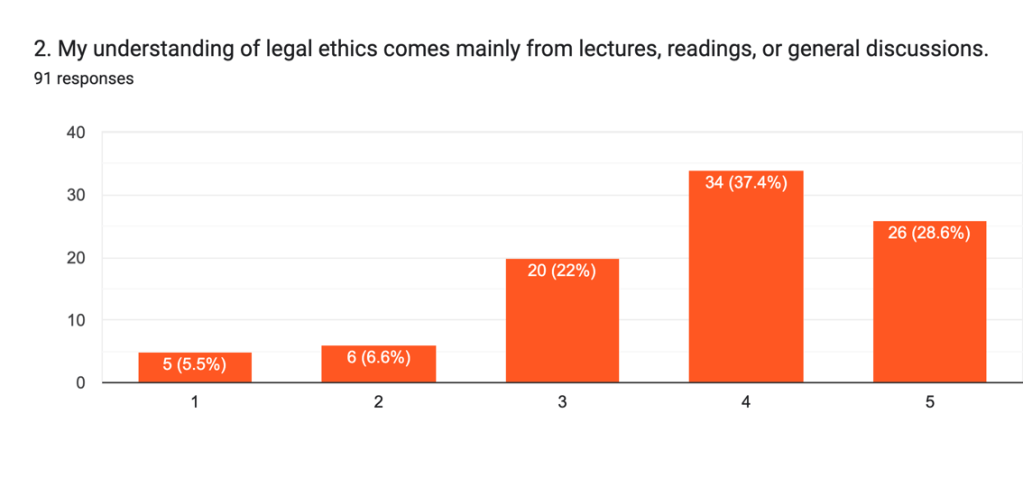
At the LLB level, students are introduced to the structure of the law. They learn principles, cases, and doctrine, often with very limited exposure to the realities of legal practice. Their understanding of what it means to be a lawyer is shaped largely by lectures, observation, and assumptions. For many, there is an underlying expectation that the profession’s practical aspect, including professional responsibility, will become clearer at a later stage.
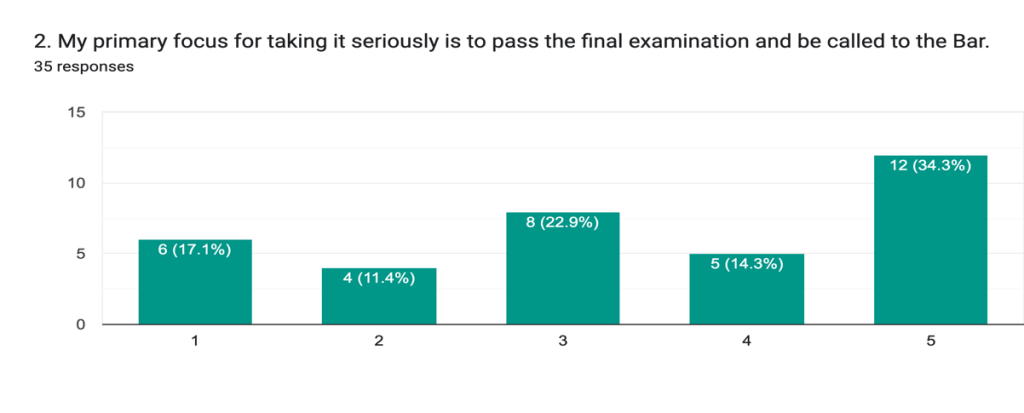
At the professional course level, ethics is taught formally. Students study the rules that govern professional conduct and are examined on them. In practice, however, the focus is often on mastering the material well enough to pass. Even where there is an intention to instil discipline, students at that stage are primarily concerned with being called to the Bar. Ethical rules are understood, but not always internalised in a way that prepares them for the complexity of real situations.
By the time practice begins, much of that knowledge sits in the background, and what comes to the fore instead are the demands of the profession.
The Pressures We Do Not Talk About
Practice introduces a different set of pressures.
In Ghana, success in the legal profession is often expected to be visible. There is an unspoken understanding that a lawyer should “look the part”: look a certain way, live a certain way, and project a certain level of achievement. Basically, the car, the suit, and the lifestyle. For many young lawyers, the pressure to meet that expectation starts quite early in their careers.
Some respond by trying to move quickly. They set up firms at a stage when they are still developing their skills. They take on matters that they are not fully prepared for. They make decisions without the benefit of experience or sustained guidance.
In larger firms, the pressure takes a different form. Billable hour targets, demanding clients, and hierarchical structures shape how young lawyers work and how quickly they are expected to deliver. There is often little space to pause, and even less room to ask questions.
The pressures of practice tend to emerge before young lawyers develop the judgment required to navigate them confidently.
“There is an unspoken understanding that a lawyer should “look the part”… Basically, the car, the suit, and the lifestyle.”
When Mentorship Is Left to Chance
Mentorship within the legal profession is often informal and uneven. Some lawyers find senior colleagues who are willing to guide them, create space for questions, and involve them in thoughtful discussions. Others do not have that experience and are left to navigate practice largely on their own, using the “trial and error” approach.
Where mentorship is absent or inconsistent, learning happens through experience, and sometimes through mistakes that could have been avoided. Over time, this shapes how lawyers respond to uncertainty, pressure, and ethical tension.
What the Responses Are Telling Us
A short anonymous survey conducted for this article reflects similar patterns across different stages of legal training and practice.
Responses were received from LLB students, students at the Ghana School of Law, and practising lawyers, with over 90 responses coming from LLB students alone. While the questionnaires for LLB and Ghana School of Law students were largely similar, the responses reveal a progression that is worth noting.
LLB Students
Many indicated that their understanding of legal practice is still largely shaped by academic exposure and observation.
There is a general expectation that key aspects of professional responsibility and decision-making will be learned later, particularly during professional training or in practice.
Students at the Ghana School of Law
Responses suggest that while ethics is formally taught, the emphasis remains largely on examination.
Many acknowledged that they are familiar with the rules governing professional conduct, but fewer felt confident about applying those rules in complex or uncertain situations. The transition from theory to practice remains, for many, an area of uncertainty.
Practising lawyers
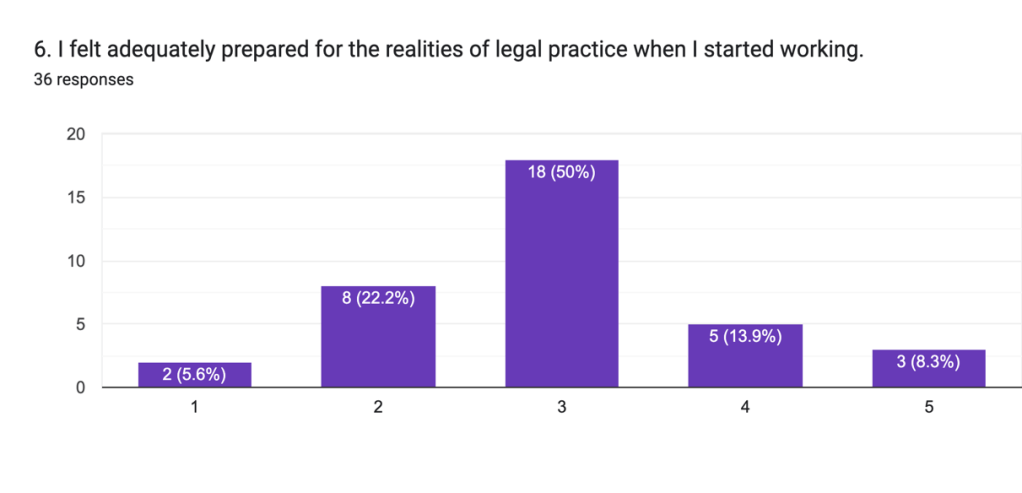
While most indicated that they had studied and understood ethical rules during the professional law course, a significant number did not feel fully prepared to navigate ethical dilemmas at the start of their careers.
Across all three groups, these responses suggest a fairly consistent trajectory: at each stage, there is an expectation that practical judgment will be developed at the next stage. In reality, that expectation is often carried forward into practice, where the need for that judgment becomes immediate.
What People Wish They Knew Earlier
Beyond the structured responses, participants were invited to reflect on what they wish they had better understood about legal practice at their respective stages. The responses, across LLB students, Ghana School of Law students, and practising lawyers, reveal some recurring themes.
A recurring theme is the gap between theory and practice.
LLB students repeatedly pointed to the difficulty of understanding how legal principles translate into real situations. Many expressed uncertainty about basic aspects of practice, including court proceedings, client interaction, and the day-to-day work of a lawyer.
This theme continues at the Ghana School of Law in a more refined form. Students identified key areas such as advocacy, procedure, client management, and legal ethics as areas where they would have preferred more practical engagement. Notably, while ethics is formally taught at this stage, it still appeared among the areas students felt least confident about.
Among practising lawyers, the reflections shift toward navigating the realities of the profession. They highlighted the need to better understand financial expectations, stress, workplace dynamics, fee structures, and early career decisions.
Across all three groups, the need for guidance is a recurring theme. Some responses stated this directly, noting that lawyers need to be more intentional about mentoring. Others pointed to specific areas where guidance would have made a difference, particularly in handling ethical uncertainty and professional relationships.
Taken together, these reflections reinforce a central point: young lawyers are often required to make decisions, sometimes significant ones, before they have had the benefit of sustained guidance on how to approach them.
“I wish I better understood how lawyers navigate ethical grey areas in practice…” (LLB Student)
Rethinking Mentorship Intentionally
If legal practice involves uncertainty, pressure, and ethical tension, why do we continue to treat mentorship as optional?
There is a strong case for more structured and intentional mentorship at each stage of legal training and practice.
At the LLB level, this may take the form of greater exposure to the realities of practice through structured conversations, practical examples, and interaction with practitioners.
At the Ghana School of Law, mentorship can complement the teaching of legal ethics by grounding rules in real scenarios and lived experience. Mandatory internships present a perfect opportunity for this.
In practice, mentorship should not be left to chance. It should be more intentional, with clearer expectations and more consistent engagement. Structured systems such as buddy programmes for interns and junior lawyers (which some firms already use), regular check-ins, and intentional mentor pairings can make a significant difference.
Young lawyers need to understand how the rules operate in situations that are not straightforward, where there is pressure to act quickly, or where competing considerations are not easily resolved.
In many ways, this reflects the role Dumbledore played: not providing constant supervision but giving timely guidance, and not giving answers but providing direction.
“I wish lawyers were more intentional about mentoring.” (Practising Lawyer)
Finding Mentorship and Making It Work
Mentorship matters at the points where judgment is formed. The question is: where does it come from, and who is responsible for making it work?
Part of the answer lies with institutions, but part of it also lies with individuals, both those seeking guidance and those in a position to offer it.
For Students and Young Lawyers
Mentorship is not always formally assigned. In many cases, it is found.
At the LLB level, this may begin with paying closer attention to the practitioners who engage with students, whether through lectures, guest sessions, internships, or moots. Reaching out does not always require a formal request. Sometimes it starts with a question, a follow-up conversation, or simply showing a sustained interest in how the work is done.
At the Ghana School of Law and in the early years of practice, the opportunities become more immediate. Senior colleagues, internship supervisors, and even slightly more experienced peers can all play a role.
Maximising mentorship requires intention. It means asking the questions that are not always asked openly:
How do you approach difficult clients?
What do you do when something does not feel right?
How do you think through decisions when the answer is not obvious?
It also requires consistency. Mentorship is rarely built in a single interaction: it develops over time through repeated conversations, observation, and reflection.
For Senior Lawyers, Lecturers, and Professors
Again, mentorship does not always require a formal structure to begin, but it does require intention.
For lecturers and professors, this may mean going slightly beyond doctrine by creating space to connect what is taught to how it plays out in practice. This also includes making themselves accessible beyond lectures, including through office hours.
For senior lawyers, mentorship often happens in moments that may seem routine: a conversation after a meeting, feedback on a draft, or a question that pushes a junior to think more critically.
These moments shape how young lawyers approach judgment, responsibility, and professional conduct.
For Institutions Within the Profession
Institutions such as the General Legal Council and the Ghana Bar Association, including the Regional Bars, are well placed to shape how mentorship is approached. This could take the form of structured mentorship programmes, pairing young lawyers with experienced practitioners, or creating platforms for sustained engagement beyond formal events.
Faculties of law also have a role to play by introducing structured interaction with practitioners, building mentorship networks, and creating more opportunities for students to engage with the realities of practice.
Some firms have already taken steps in this direction through buddy systems and internal mentorship frameworks for interns and junior lawyers. If applied more consistently, these models can provide a level of support that is currently uneven across the profession.
Professional Misconduct and the Mentorship Gap
Across training and practice, a pattern emerges: students learn the rules and pass examinations, then enter practice expecting clarity to come with experience. What they encounter instead are situations that require judgment, often without sustained guidance.
The conversation about professional misconduct often begins at the point of failure. However, misconduct is not always the result of a disregard for the rules. In some cases, it reflects the absence of guidance at critical moments.
This does not remove personal responsibility. It does, however, raise an important question about whether existing structures adequately support the development of judgment.
Mentorship, in this context, is therefore about creating space for questions that are rarely asked openly and making room for reflection in a profession that often rewards speed and output in addition to career progression. It is also about ensuring that young lawyers are not left to navigate ethical uncertainty alone, particularly in environments where the cost of getting it wrong can be high.
The legal profession places significant emphasis on knowledge, competence, and performance. If we accept that pressure and ambiguity are part of legal practice, then mentorship must become part of how the profession understands training, development, and responsibility.
“However, misconduct is not always the result of a disregard for the rules. In some cases, it reflects the absence of guidance at critical moments.”
Not Every Lawyer Meets a Dumbledore
Not every lawyer will find a Dumbledore: their version of a guiding figure who takes a deliberate interest in their development. Yet, where that kind of guidance exists, it often shapes both competence and judgment. At critical moments, mentors do not provide all the answers, but they ask the right questions and influence how decisions are made.
Appendix: Survey Insights and Selected Responses
This article draws on responses from short anonymous surveys conducted among LLB students, Ghana School of Law students, and practising lawyers. The surveys explored perceptions of legal practice, preparedness for ethical decision making, and access to mentorship. The responses provide a useful snapshot of common experiences that support the broader argument on the role of mentorship in legal practice.
A. Overview of Participants
Total respondents: 162
LLB students: 91
Ghana School of Law students: 35
Practising lawyers: 36
B. Key Themes Across All Groups
Persistent gap between theory and practice
Limited confidence in applying ethical rules
Strong demand for practical exposure
Lack of structured and intentional mentorship
Uncertainty around career direction and early professional decisions
C. Selected Responses
The Theory–Practice Gap
“I wish I understood how legal principles are applied in real-life practice…” (LLB Student)
“Procedure generally seems to be too theoretical rather than practical.” (Ghana School of Law Student)
“Understanding how the court system works in practice.” (Practising Lawyer)
Ethical Uncertainty and Professional Responsibility
“I wish I better understood how lawyers navigate ethical grey areas in practice…” (LLB Student)
“Ethics.” (Ghana School of Law Student)
“Early mistakes and the challenges one is likely to face as a young lawyer.” (Practising Lawyer)
Practical Skills and Exposure
“Basic court proceedings and client interactions.” (LLB Student)
“The administrative process like filing documents and service.” (Ghana School of Law Student)
“More hands-on practice and exposure.” (Practising Lawyer)
Career Direction and Professional Identity
“The various areas of practice beyond litigation and what they entail.” (LLB Student)
“Navigating options for my legal career.” (Ghana School of Law Student)
“I wish someone had guided me on the right paths to take after law school in terms of which firm or company to work with.” (Practising Lawyer)
Career Direction and Professional Identity
“Generally, how the practice works. It looks like a lot of mentoring happens before the practice.” (LLB Student)
“MENTORSHIP.” (Ghana School of Law Student)
“How to handle the stress and imposter syndrome.” (Practising Lawyer)
For transparency and further engagement, anonymised responses from each group can be accessed below:
These responses are not exhaustive, but they point to a consistent pattern across the different stages of legal training in Ghana. The issue is not only that students and young lawyers learn the rules but that they are often left to figure out how to apply them without guidance.



 B. Crentsil Legal
Leave a comment