
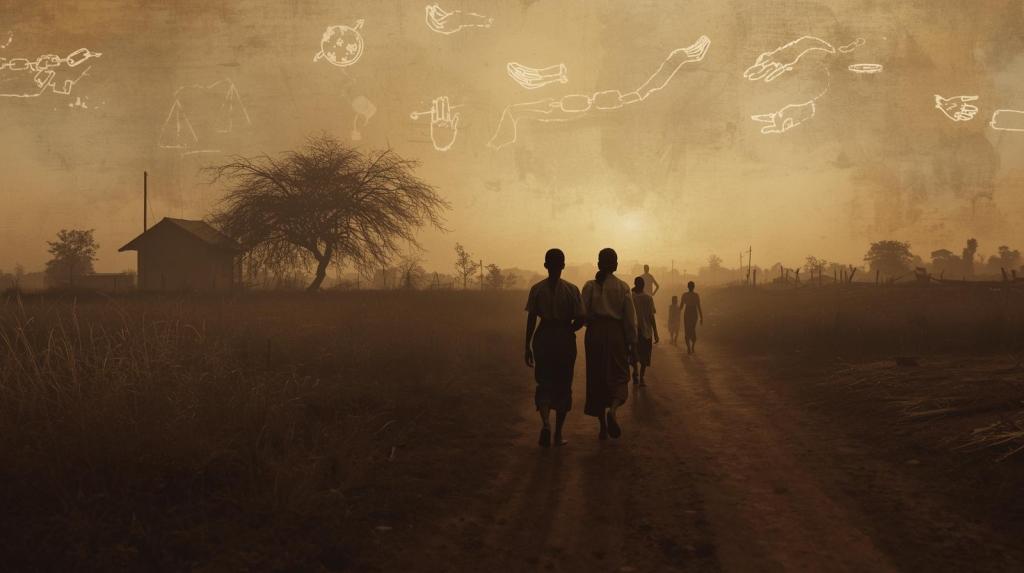
A woman from the town of Jillig Number 2, near the Gambaga witch camp, was accused of witchcraft after a child in her community fell ill. The illness was blamed on a bat that had flown over the child. A mob concluded that the woman was responsible. She was beaten until she lost consciousness and then set on fire. She died, leaving behind three children aged 11, 9, and 7. “These children have no mother, and their father has already died,” said the town chief. “These children can no longer do anything. They have no mother. They have no father. It has been left in my hands to make sure they get some daily bread. We have these orphans without anything to support them.”[1]
- 1.0 Introduction
Although it may seem unimaginable in this twenty-first century because of our perceived progress in human rights, witch camps still exist in parts of Africa, including Ghana. There is limited advocacy specifically addressing their existence, and when they are discussed, the focus is usually on culture rather than on rights, accountability, and state responsibility. The silence surrounding these camps reflects the very neutrality that Desmond Tutu warned against[2], and it highlights the urgent need to address this persistent form of gendered injustice.
Witch camps in Ghana are informal settlements, primarily in the Northern Region, that serve as homes for individuals, mostly elderly women, accused of witchcraft.[3] These camps, located in towns such as Gambaga[4], Kukuo[5], and Gnani[6], have become semi-permanent homes for hundreds of women who have been exiled from their communities following accusations of witchcraft.[7] As of 28th July 2023, a report indicated that about 539 people lived in these camps.[8] Allegations of witchcraft are deeply rooted in cultural and spiritual beliefs. They are often spurred by unexplained illnesses, deaths, or sheer misfortune that happen in a town or to a family member. Once accused, women are forced to choose between fleeing to a camp or facing violence in their communities.
Ghana is not unique. Across parts of Africa, Asia, and the Pacific, women accused of witchcraft face violence, exile, and death. In Tanzania, elderly women have been killed after being accused of causing misfortune.[9] In Nigeria, both women and children have been subjected to abuse following accusations by religious figures.[10]
The continued existence of witch camps in Ghana represents a violation of human rights norms, both at the national and international levels, particularly those related to the rights of women and girls to live free from violence, discrimination, and harmful traditional practices.
- 2.0 Historical, Cultural, and Social Roots of Witchcraft Accusations
Belief in witchcraft in Ghana dates back centuries and is heavily influenced by traditional belief systems. It is used to explain misfortunes, such as crop failure, death, or disease.[11] In precolonial and colonial periods, belief in witchcraft was interwoven with indigenous religious practices and social control mechanisms.[12]European colonists and missionaries reinterpreted these belief systems and used the term “witchcraft” to describe the indigenous African religious beliefs and rituals they saw.[13] Colonialism, Christianity, Islam, and other religions have all influenced Ghanaian notions about witchcraft.[14] Over time, these accusations have disproportionately targeted women, particularly elderly women, women living with disabilities, widows, or those without strong male relatives.[15]
These accusations rarely follow due process or evidence-based inquiry.[16] In the Ghanaian case of Abotchie v Nuumo, Abban J (as he then was) held that the traditional mode or method of proving witchcraft which the defendant intended to adopt had not gained any recognition in the courts of law and it should not be countenanced because the evidence which the fetish priest would offer to show that the plaintiff was a witch would be nothing but hearsay and therefore inadmissible.[17]
Accusations of witchcraft are rather based on dreams, visions, rumours, or the testimonies of spiritual leaders or family members. Once an accusation is made, there is no meaningful opportunity for defence. The accused persons are left to choose between exile to a witch camp or facing violence, sometimes fatal, at the hands of their communities.
- 3.0 Life in Witch Camps
Witch camps are described as places of refuge, but this description masks the reality of life there – the inhabitants live in harsh conditions.[18] Women live in basic huts, with limited access to clean water, adequate food, health care, or sanitation.[19] Many depend on charity for survival.
Movement in and out of the camps is frequently restricted, either by camp authorities or by fear of attack if a woman attempts to return home. These restrictions are sold to the women and justified as protective measures, but in reality, they limit freedom of movement and amount to forced confinement. The social stigma attached to being labelled a witch continues to follow these women, even within the camps themselves.[20]
- 4.0 Human Rights Violations
The existence and conditions of witch camps in Ghana raise serious concerns under international human rights law. Many women there live under forced isolation, unsafe living conditions, and constant social stigma. This places Ghana in tension with several international instruments to which it has committed itself.
- Universal Declaration of Human Rights (UDHR).[21]
The treatment of women in witch camps is fundamentally inconsistent with the guarantees set out in the UDHR, which affirms that every person has the right to life, liberty, and security.[22] The environment threatens their safety, restricts their movement, and denies them access to adequate food, shelter, and health care.
The UDHR also prohibits cruel, inhuman, and degrading treatment.[23] The overcrowded and unsanitary conditions in the camps, combined with social exclusion and public stigma, create environments that strip women of dignity and subject them to both physical and psychological harm.
- Convention on the Elimination of All Forms of Discrimination Against Women (CEDAW).[24]
Ghana’s obligations under the CEDAW require it to eliminate discrimination against women and challenge social and cultural practices that reinforce gender inequality.[25] Witch camps disproportionately affect women, particularly elderly women, widows, and women without strong family protection. Once accused, these women are denied access to essential services, such as access to health care guaranteed by the CEDAW, and are excluded from social and economic life.[26]
- International Covenant on Civil and Political Rights (ICCPR).[27]
The ICCPR guarantees the right to liberty and security of the person.[28] Women sent to witch camps are confined without legal process, judicial review, or consent. In many cases, they cannot leave safely due to threats of violence or social retaliation. This form of confinement amounts to arbitrary detention. According to General Comment No. 35, deprivation of liberty includes any situation in which an individual is confined to a limited space without free consent, recognizing that it does not require formal imprisonment.[29]
By allowing witch camps to operate, Ghana fails to protect individuals, particularly elderly, widowed, or socially vulnerable women, from the unlawful deprivation of liberty, although the state does not formally operate the camps.
- Convention on the Rights of the Child (CRC).[30]
Witchcraft accusations do not affect only women. They also disrupt children’s lives. In many cases, women accused of witchcraft are forcibly separated from their children without any formal assessment of the children’s welfare. In other situations, children accompany their mothers to camps where they face unsafe living conditions, limited access to education, and social stigma.
The CRC stresses the importance of family unity[31] and requires states to protect children from physical and emotional harm.[32] The forced displacement of mothers and the exposure of children to unsafe and marginalized environments undermine these protections and place children at risk of long-term developmental harm, contrary to their best interests.[33]
- Convention on the Rights of Persons with Disabilities (CRPD).[34]
Women with disabilities are particularly vulnerable to witchcraft accusations. Behaviour linked to dementia, mental illness, or other cognitive conditions is misinterpreted as spiritual cases.[35] Instead of receiving medical care or social support, affected women may be expelled from their communities and confined in witch camps.
The CRPD affirms that persons with disabilities have the same rights to liberty, security, and dignity as others.[36] The confinement of women with disabilities in witch camps signals gender discrimination, disability stigma, and social exclusion, all of which the CRPD seeks to eliminate.
- 5.0 Government Action and Legislative Reform
Ghana has taken gradual steps to address the issue of witch camps. The most significant recent effort was the introduction of a Bill to Parliament by Honourable Francis-Xavier Sosu, Esq., Member of Parliament for Madina,[37] who has emerged as the lead advocate for dismantling these camps.[38]
This Bill seeks to criminalize witchcraft accusations, impose penalties on perpetrators, and establish a legal framework for victim protection, rehabilitation, and reintegration.[39] It is grounded in Ghana’s international and constitutional obligations to safeguard the rights to dignity, equality, personal liberty, and freedom from inhumane and degrading treatment.[40]
The Bill recognizes that witch camps are not only a human rights crisis but also a social and economic burden on the state.[41] Estimates cited by the Member of Parliament indicate that maintaining these camps costs Ghana approximately GH₵25 million. These funds are currently used to provide minimal shelter, food, and basic health services for residents. Redirecting such resources towards sustainable social welfare and reintegration programs would promote long-term social stability while addressing the root causes of exclusion and marginalization.[42]
The failure of the Bill to receive presidential assent in 2023 highlighted the political sensitivity of the issue and the reluctance to confront harmful practices framed as cultural or religious.
While the government has made past efforts to close down these camps,[43] these have largely been ineffective due to insufficient community engagement, inadequate funding, and the absence of long-term psychosocial and economic support for victims. The Ministry of Gender, Children, and Social Protection, in collaboration with NGOs, has introduced shelter programs and vocational training initiatives, but these remain inadequate without systematic state intervention.[44]
- 6.0 Role of the Media, Civil Society, and International Community
Media
Ghana’s media has been instrumental in raising public awareness about the plight of women in witch camps. Platforms such as Graphic Online, Ghana Web, and ModernGhana have published in-depth reports and feature articles that detail the living conditions, human rights violations, and social exclusion faced by women accused of witchcraft. JoyNews, a leading television and online news platform in Ghana, has produced documentaries that have brought the lived experiences of women and children in witch camps to national attention. Notably, the JoyNews documentary “Serving the Witches”,[45] written and produced by Justice Baidoo, highlights the situation of children living in witch camps, exposing the hardships they face and the impact of stigma and exclusion on their lives.
By combining investigative reporting, personal narratives, and visual storytelling, the media has helped break the silence around witchcraft accusations and witch camps, making it harder for society and policymakers to ignore the issue.
Civil Society Organizations (CSOs)
CSOs have also been at the forefront of advocacy, providing legal aid, shelter, and public education. Groups such as ActionAid[46] and the Coalition Against Witchcraft Association (CAWA)[47] have engaged in public sensitization campaigns and direct support for reintegrated women. ActionAid, in particular, has in its report on Ghana titled “Condemned Without Trial”, documented its extensive efforts, including legal representation, community sensitization campaigns, and economic support programs for women accused of witchcraft.[48] It also collaborates with local stakeholders to conduct outreach and training workshops designed to challenge entrenched beliefs about witchcraft and promote the rights of women.
International Community
At the international level, Ghana has faced sustained scrutiny through the United Nations Human Rights Council’s Universal Periodic Review process. Ghana has been urged to take decisive action to eliminate harmful traditional practices, such as witch camps.[49] The recommendations made at the international level include: Swiftly enacting laws to criminalize witchcraft accusations; Facilitating the safe resettlement and rehabilitation of women and their dependents from witch camps, with access to legal remedies; Introducing protective measures for individuals at risk of such accusations; and Conducting widespread awareness campaigns to dispel witchcraft myths and reduce stigma.[50]
The consistent discussion of such practices has exerted pressure on Ghana, encouraging advocacy, legal reform, and increased state accountability.
- 7.0 Recommendations
Dismantling witch camps must be accompanied by broader reforms. A successful reform strategy is one that integrates a multifaceted approach that combines legislative change with grassroots education, economic empowerment, community dialogue, and psychosocial rehabilitation.
Community Education
The National Commission for Civic Education (NCCE), as a constitutional body mandated to educate citizens on their rights and responsibilities, is well-positioned to lead nationwide awareness campaigns.[51] Because of its widespread presence across the country, it can help change the narratives and support the reintegration of survivors by engaging local leaders, traditional authorities, religious groups, youth associations, and women’s organizations in structured dialogues through community engagement, media outreach, and partnerships.
Legal Aid and Psychosocial Support
Victims will need legal representation to access justice and enforce their rights, following the passage of the Bill. They should also be given psychosocial support, in the form of trauma counseling and mental health care, to recover from stigma and abuse.
Economic Empowerment and Reintegration
To ensure that women accused of witchcraft successfully reintegrate into society, they should be empowered economically. Reintegration programs should include vocational training, access to microfinance, start-up capital, and financial literacy education to help survivors rebuild their lives. These initiatives must be tailored to the women’s needs and supported by community sensitization to reduce the risk of re-accusation.
Legal Safeguards
A critical step to reform will be the passage of the pending Bill currently before Parliament. This will be a necessary legislative measure aligned with international human rights obligations, such as the mandate to enact appropriate legal and institutional reforms to protect women’s rights, combat harmful traditional practices, and ensure access to justice for the vulnerable under CEDAW.
Strong Institutional Support
Legislative reform must be complemented by strong institutional support. This should include training law enforcement and judicial officers on the new legal provisions of the Bill, setting up specialized units within the Ghana Police Service to handle witchcraft-related accusations, and establishing community watchdog committees to monitor and report violations.
If all these measures are properly implemented, it would position Ghana as a leader in the global movement to eliminate harmful traditional practices against women.
- 8.0 Conclusion
The continued existence of witch camps in Ghana shows how poverty, gender inequality, and harmful traditional beliefs still shape the lives of many vulnerable women. These camps raise serious concerns about dignity, safety, and basic human rights, and they deserve attention both nationally and internationally. Ending them requires political will, legal reform, community engagement, and sustained investment in the dignity and safety of women who have been banished and forgotten for too long.
[1] ActionAid, Condemned without Trial: Women and Witchcraft in Ghana (ActionAid 2012) https://www.actionaid.org.uk/sites/default/files/publications/condemned_without_trial_women_and_witchcraft_in_ghana_report_september_2012.pdf accessed 22 January 2026.
[2] Desmond Tutu, ‘If you are neutral in situations of injustice, you have chosen the side of the oppressor’
[3] ‘Witch camp’ Wikipedia https://en.wikipedia.org/wiki/Witch_camp accessed 22 January 2026; ‘Witch Camps in Ghana’ (Religion and Public Life, Harvard Divinity School, 23 July 2020) https://rpl.hds.harvard.edu/religion-context/case-studies/violence-peace/witch-camps-ghana accessed 22 January 2026.
[4] BBC, programme page (BBC iPlayer) https://www.bbc.co.uk/programmes/p0cmjsvn accessed 22 January 2026.
[5] BBC News, ‘Ghana Witch Camps: Widows’ Lives in Exile’ (31 August 2012) https://www.bbc.com/news/magazine-19437130 accessed 22 January 2026.
[6] Leo Igwe, ‘Gnani: A Witch Camp and Its Wizards in Ghana’ ModernGhana (18 February 2013) https://www.modernghana.com/news/446198/gnani-a-witch-camp-and-its-wizards-in-ghana.html accessed 22 January 2026.
[7] ‘Witch Camps in Ghana’ (Religion and Public Life, Harvard Divinity School, 23 July 2020) (n 3) accessed 22 January 2026.
[8] ‘All witch camps will be disbanded after passage of witchcraft accusations law – Francis Sosu’ MyJoyOnline (28 July 2023) https://www.myjoyonline.com/all-witch-camps-will-be-disbanded-after-passage-of-witchcraft-accusations-law-francis-sosu/ accessed 22 January 2026.
[9] Gerald K Komba, ‘Vulnerability of Elderly Women to Witchcraft Accusations among the Fipa of Sumbawanga (1961–2010)’ (2015) https://www.researchgate.net/publication/283109690_Vulnerability_of_elderly_women_to_witchcraft_accusations_among_the_fipa_of_Sumbawanga_1961-2010 accessed 23 February 2026.
[10] Sharon B Bello, The Accusation of Elderly Women as Witches in Nigeria (MA Development Studies thesis, Erasmus University Rotterdam 2020) https://thesis.eur.nl/pub/55496/RP_S._Bello_.pdf accessed 23 February 2026.
[11] Boubakar Sanou, ‘Witchcraft Accusations: Destroying Family, Community, and Church’ (2017) 13(1) Journal of Adventist Mission Studies 33, 33–44 https://digitalcommons.andrews.edu/jams/vol13/iss1/5 accessed 23 January 2026.
[12] S Mesaki, ‘The Colonial State and Witchcraft: Moral Crusade or Ethnocentric Phobia – The Case of British Colonialism in Tanganyika’ (1997) 3(1) Tanzania Zamani https://journals.co.za/doi/10.10520/AJA08566518_20 accessed 23 January 2026.
[13] ‘Witch Camps in Ghana’ (Religion and Public Life, Harvard Divinity School, 23 July 2020) (n 3) accessed 14 January 2026.
[14] Ibid.
[15] Mensah Adinkrah and Prakash Adhikari, ‘Gendered Injustice: A Comparative Analysis of Witchcraft Beliefs and Witchcraft Related Violence in Ghana and Nepal’ (2014) 6(10) International Journal of Sociology and Anthropology 314, 317 https://doi.org/10.5897/IJSA2014.0560 accessed 23 January 2026.
[16] Abotchie v Nuumo [1974] 1 GLR 142
[17] Ibid.
[18] Amnesty International, Ghana: Branded for Life: How Witchcraft Accusations Lead to Human Rights Violations of Hundreds of Women in Northern Ghana (Amnesty International 2025) https://www.amnesty.org/en/documents/afr28/9099/2025/en/ accessed 23 February 2026.
[19] Ibid.
[20] Human Rights Watch, ‘Ghana: Submission for the Universal Periodic Review, 42nd Session, January 2023’ (14 July 2022) https://www.hrw.org/news/2022/07/14/ghana-submission-universal-periodic-review accessed 14 January 2026.
[21] Universal Declaration of Human Rights, GA Res 217A (III) (10 December 1948).
[22] Ibid, art 3.
[23] Ibid, art 5.
[24] Convention on the Elimination of All Forms of Discrimination against Women (adopted 18 December 1979, entered into force 3 September 1981) 1249 UNTS 13 (CEDAW).
[25] Ibid, arts 2, 5.
[26] Ibid, arts 12, 15.
[27] International Covenant on Civil and Political Rights (adopted 16 December 1966, entered into force 23 March 1976) 999 UNTS 171 (ICCPR).
[28] Ibid, art 9.
[29] UN Human Rights Committee, ‘CCPR General Comment No 35: Article 9 (Liberty and Security of Person)’ (16 December 2014) UN Doc CCPR/C/GC/35 https://docs.un.org/en/CCPR/C/GC/35 accessed 23 February 2026.
[30] Convention on the Rights of the Child (adopted 20 November 1989, entered into force 2 September 1990) 1577 UNTS 3 (CRC).
[31] Ibid, art 9(1).
[32] Ibid, art 19.
[33] Ibid, art 3.
[34] Convention on the Rights of Persons with Disabilities (adopted 12 December 2006, entered into force 3 May 2008) 2515 UNTS 3 (CRPD).
[35] Leo Igwe, ‘World Day against Witch Hunts: People with Dementia Are Not Witches’ ModernGhana (Accra, 2 August 2023) https://www.modernghana.com/news/1249159/world-day-against-witch-hunts-people-with-dementi.html accessed 23 January 2026.
[36] CRPD (n 34), art 14.
[37] Parliament of Ghana, ‘Member of Parliament: Francis Xavier Sosu’ https://www.parliament.gh/members?mp=94023 accessed 22 January 2026.
[38] ‘Sosu leads charge of 10 MPs to push Anti-Witchcraft Bill’ GhanaWeb (7 March 2025) https://www.ghanaweb.com/GhanaHomePage/NewsArchive/Sosu-leads-charge-of-10-MPs-to-push-Anti-Witchcraft-Bill-1974419 accessed 14 January 2025.
[39] ‘CHRAJ Wants Criminal Offences (Amendment) Bill 2022 Assented To …To Ban Witchcraft Accusation’ (Commission on Human Rights and Administrative Justice, 5 March 2025) https://chraj.gov.gh/2025/03/05/chraj-wants-criminal-offences-amendment-bill-2022-assented-to-to-ban-witchcraft-accusation/ accessed 14 January 2026.
[40] Constitution of the Republic of Ghana, ch. 5.
[41] ‘Ghana will save GH₵25 million when witch camps are disbanded – Sosu explains’ GhanaWeb (Accra, 15 April 2025) https://www.ghanaweb.com/GhanaHomePage/NewsArchive/Ghana-will-save-GH-25-million-when-witch-camps-are-disbanded-Sosu-explains-1980045 accessed 23 January 2026.
[42] Ibid.
[43] Women’s International League for Peace and Freedom, ‘HRC53 Statement on the UPR of Ghana’ (6 July 2023) https://www.wilpf.org/wp-content/uploads/2023/08/HRC53-Statement-on-the-UPR-of-Ghana-.pdf accessed 14 January 2026.
[44] Ibid; The Former Attorney-General and Minister for Justice, H.E. Godfred Yeboah Dame, recalled during the Working Group session of UPR that Ghana was undertaking efforts to close witch camps, but some challenges persisted, such as the slowness of the process and the difficulties making the camps habitable. He also indicated that in the meantime, the Gender Ministry had embarked upon sensitization programs, awareness-raising campaigns and relief support interventions in the camps and the communities. He added that additional progress had been achieved in eliminating witchcraft accusations through the introduction of a witchcraft accusation bill before the Parliament, which aims at criminalizing any such accusations
[45] Serving the Witches (Hotline documentary, JoyNews, 4 March 2020) https://www.youtube.com/watch?v=NxnIN7UYdaw accessed 23 January 2026.
[46] ActionAid (n 1).
[47] Coalition Against Witchcraft Accusation (CAWA), ‘Press Release: Conviction of Akua Denteh’s Killers and the Need to Pass Anti-Witchcraft Accusation Bill Currently Languishing in Parliament’ (The Sanneh Institute, 20 July 2023) https://tsinet.org/wp-content/uploads/2023/07/PRESS-RELEASE-JULY-2023.pdf accessed 14 January 2026.
[48] ActionAid (n 1).
[49] Women’s International League for Peace and Freedom (n 43).
[50] Ibid.
[51] Constitution of the Republic of Ghana 1992, ch 19.

 B. Crentsil Legal